


Malaysian Garden Design Identity


Almost complete now is the myth that there are yet pristine and untouched parts of Nature somewhere to be found. In many places, Nature's coarse and oft uncouth lineaments have been plied at, and where she once appeared wanton, civilization has draped her with its censorial loin-cloth.
What the word "nature" now constitutes is, rather, the varying degrees of her former sylvan self from her sullied wilderness to the semi-tamed bucolics of her unruly parts, towards areas where patches of her former self can still be guessed at, and finally, the urban holocaust of her former colony which has left her barren.
However, despite the destruction of it, our nostalgia for that "lost wilderness" has often led towards the reconstruction of an image of nature which, for most of us, takes the form of a few potted plants and trees in the "small" of our backyard.
Many have tried to emulate Nature's original charms by creating various identities for her. The Victorian, Japanese and Balinese gardens, for instance, were all cultural attempts at recreating some of the pleasures which Nature bestowed.
Here, too, an effort to forge a cultural identity for our local gardens is now being made, with the realization that we, who had dreamt of the heritage of lush countryside (a place where one can escape from city life), have been cheated of our legacy.

With this in mind, a team of three landscape designers from Terra Garden - Desmond Ho, Yim Wooi Hoh and Mohammad Razlan – travelled the country in search of those surviving emblems of the "good ol' pastoral" life, from which an identity could be formed for an urban Malaysian garden.
Thus the concept of Malaysian Garden came about (which derived its name from the Malay-Sumatran- Borneo Archipelago). It was germinated from the idea that an urban garden should engage all five senses of a person. How, then, should one's senses be lulled or engaged to excite the illusion of closeness with nature?
The first step towards capturing the vision of an ideal arbor began with a trip down memory lane for Ho and his team, reliving vicariously the days when they were kampung boys.
Days such as those were filled with jocund jaunts down rivers, mulling at pleasure glades where the arboreal creatures, wind, shadow-breeding foliage, and a host of other variables contrived to wile and lure the senses. It was through this vision that many of those variables mentioned above were simulated for the Malaysian Garden.
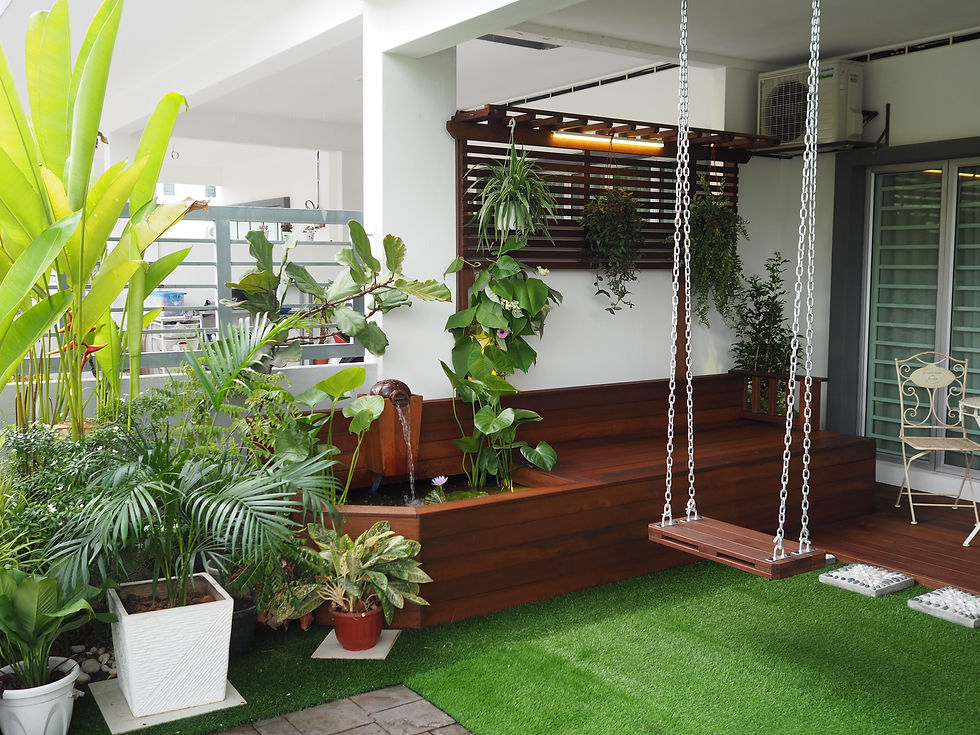
Then came the idea of introducing into this envisioned haven the comforts of indoor accoutrement, which started the query for quaint and rustic artifacts and implements that can be adapted for lounging purposes and blended with the garden as well. Shapes and designs of traditional objects such as the pangkin (a sort of wooden plinth made from cengal wood), tempayan (ceramic water jar), kuda-kuda (a two-tier wooden bench used for grinding coconuts) and others were borrowed and re-fashioned to furnish the garden.

The remake of the pangkin and kuda-kuda is comfortable for sitting as well as laying down. Apart from fulfilling the tactile and visual need for that urban contrast, Ho and his team wanted to instill the garden with sound, scent and taste effects as well. Sound effects for the Malaysian Garden were enacted with the basic hydraulics of fancy geysers (such as the Telaga Tiga pot with three sprouts) and miniature falls of the Pancuran Ledang (where water accompanied by light effects flows from earthen jars attached to a vertical woodwork of intricate design). As for scent and taste, a combination of fragrant plants (Champaka, Frangipani, Muraya and Melur to name a few) can be used.
Ho said the features of a Malaysian Garden can be structured in many ways according to the practical and aesthetic needs of the individual. For example, if one were to have a small indoor garage, Malaysian Garden elements could be customized to fit the enclosure, bestowing on it a rather romantic feel. Currently, Ho and his team are working out a series of Malaysian Garden designs, the first of which (Pangkin Puteri Ledang) has already been completed.
The ensuing series, which would all be named after local myths and legends, would be an attempt to renew the awe and magic of folklore, most of which are lost to urban kids, through the art of landscaping.
Having won the recent Water Landscaping competition at Shah Alam, the Malaysian Garden concept can be said to have kicked off pretty well. The ultimate aim, however, for Ho and his team would be to earn a place at England's Chelsea gardening show (a world class event), where its representation might well be the means of placing Malaysian Garden among the other international gardens.



Comments